Introduction Parkinson’s disease

- Parkinson’s disease is a neurodegenerative disorder.
- Parkinson’s disease was first described by James Parkinson in 1817 as “shaking palsy“.
- Parkinson’s diseases mainly affect the central nervous system (CNS).
Definition of Parkinson’s disease
Parkinson’s disease is a chronic, progressive neurodegenerative disorder that affects the basal ganglia of the brain and leads to a deficiency of dopamine neurotransmitters. Decrease dopamine neurotransmitter level in the body cause the tried symptoms –
- Tremor
- Bradykinesia
- Rigidity.
Causes of Parkinson’s disease
- Idiopathic
- Genetic disorder
- Age factors
- Exposure to toxin
- Sex (men more exposure)
- Deficiency of dopamine
- Arterial hypertension
- Affect substantia nigra
- Carbon monoxide
- Head injury
- Exposure to Toxins
- Encephalitis
- Atherosclerosis
- Environmental triggers.
-

What is Parkinson’s Disease Causes, Symptoms & Treatment
Pathophysiology (Process of Parkinson’s disease)
Cause
↓
Affect the substantia nigra of basal ganglia
↓
Decrease dopamine production
↓
Degeneration of neurons in basal ganglia
↓
Affect daily routine activity and cause the tremor, rigidity or bradykinesia
↓
Parkinson disease.
Symptoms/Signs of Parkinson’s Disease
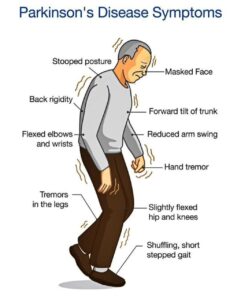
- Classical symptoms of Parkinson – tremor
Symptoms/Signs of Parkinson’s Disease
- Rigidity
- Bradykinesia.
- Masks like facial expressions.
- Immobile daily activity
- Wrist sluggish moment
- Shuffling gait
- Speech difficulty
- Dysphagia
- Balance problem
- Propulsive gait
- Impaired gross motor coordination
- Loss of sense of smell
- Swallowing and chewing difficulty
- Frothy saliva from the mouth
- Stop automatic swinging of hand during the walk
- Stooped posture
- Dystonia
- Sexual dysfunction
- Micrographic

What is Parkinson’s Disease Causes, Symptoms & Treatment - Constipation.
Diagnosis of Parkinson’s Disease
- History collection and physical examination.
- CT scan and MRI
- Imaging test
- PET scan
- Mental status examination.
Treatment of Parkinson’s disease
- Levodopa and carbidopa
- Dopamine agonist – bromocriptine
- Anticholinergics – benztropine.
- Monoamine oxidase type – B (MAO – B)
- Antihistamine
- Tricyclic medication
- COMT inhibitor (catechol – o – methyltransferase inhibitors)
- Antiviral substance.
Complications in Parkinson’s disease
- Disability
- Aspiration
- Sexual dysfunction
- Dementia
- Injury from fall
- Cognitive problem.
Who to Manage Parkinson’s disease Patients
- Nurses monitor patients’ daily activity and vital signs.
- Assess physical examination and mental ability.
- Assess patient chewing and swallowing ability.
- Provide soft and fibre diet for easily eating.
- Nursing encourages patients for daily active and passive movement.
- Provide physical and occupational therapy.
- Provide a medical alert bracelet.
- Provide all prescribed medication and maintain IV therapy.
- The nurse monitors the respiration pattern.
- Nurses educate to avoid – high heel shoes
- Hard mattress use
- Vitamin B6.
- The nurse will encourage the patient to do minor tasks.
- The nurse will assist the patient while descending the stairs.
- The nurse will explain to all family members about Parkinson’s.
Important Points about Parkinson’s disease
- What was the first name of Parkinson’s disease – Shaking palsy?
- Parkinson’s disease is a – Neurodegenerative disorder.
- Tried symptoms of Parkinson’s disease – Tremors, rigidity, and bradykinesia.
- The most common cause of Parkinson’s disease – Dopamine deficiency.
- Which neurotransmitter affects Parkinson’s disease – Dopamine
- Parkinson’s disease was discovered by – James Parkinson.
- Parkinson’s disease is a – Progressive brain disorder.
- The average age of onset of Parkinson’s disease is about – 60.
- How many stages of Parkinson’s disease – 4.
- Parkinson’s disease is most commonly found in – Males.
Parkinson’s disease Slideshare
FAQ About Parkinson’s Disease:
What was the first name of Parkinson’s disease?
Shaking palsy
What is Parkinson’s disease?
Neurodegenerative disorder.
What have Tried symptoms of Parkinson’s disease?
These 3 are the main signs of Parkinson’s disease> tremors, rigidity, and bradykinesia.
Which neurotransmitter affects Parkinson’s disease
Dopamine
Parkinson’s disease was discovered by
James Parkinson.
Parkinson’s disease is most commonly found in
Males then Females
-
solapur nursing vacancy 2022 post 114 apply now
Solapur Nursing Vacancy 2022 Post 114 National health mission NHM released a new nursing vacancy notification Zilla Parishad Solapur has released the latest job notification for the post of a medical officer, Health Superintedent, and MPW with 114 posts. In this whose, Condideats apply MBBS, GNM/B.Sc.Nursing.And m.Sc Candidates Are eligible for this post. Interested…
-
108 ambulance staff nurse vacancy 2022 rajasthan
108 ambulance staff nurse vacancies 2022 GVK EMRI is a Private organization, that conducts a free ambulance service in India. GVK EMRI announce a Vacancy for 108 Nursing staff and Ambulance drivers combined vacancy notifications are released. These vacancies Interview based vacancy: Educational Qualification B.Sc. Nursing/GNM Experience Minemum6 Month Nursing experience And LVM/HVM License Maximum…
-
The best diets for 25+ health conditions – mission nursing
the best diets for 15 common health conditions 1. Acute Renal Disease Dite —protein-restricted, high-calorie, fluid-controlled, sodium and potassium controlled. 2. Addison’s disease Dite —increased sodium, low potassium diet. 3. ADHD and Bipolar Dite —high-calorie and provide finger foods. 4. Burns Dite —high protein, high caloric, increase in Vitamin C. 5. Cancer Dite —high-calorie, high-protein. 6.…