Introduction Parkinson’s disease

- Parkinson’s disease is a neurodegenerative disorder.
- Parkinson’s disease was first described by James Parkinson in 1817 as “shaking palsy“.
- Parkinson’s diseases mainly affect the central nervous system (CNS).
Definition of Parkinson’s disease
Parkinson’s disease is a chronic, progressive neurodegenerative disorder that affects the basal ganglia of the brain and leads to a deficiency of dopamine neurotransmitters. Decrease dopamine neurotransmitter level in the body cause the tried symptoms –
- Tremor
- Bradykinesia
- Rigidity.
Causes of Parkinson’s disease
- Idiopathic
- Genetic disorder
- Age factors
- Exposure to toxin
- Sex (men more exposure)
- Deficiency of dopamine
- Arterial hypertension
- Affect substantia nigra
- Carbon monoxide
- Head injury
- Exposure to Toxins
- Encephalitis
- Atherosclerosis
- Environmental triggers.
-

What is Parkinson’s Disease Causes, Symptoms & Treatment
Pathophysiology (Process of Parkinson’s disease)
Cause
↓
Affect the substantia nigra of basal ganglia
↓
Decrease dopamine production
↓
Degeneration of neurons in basal ganglia
↓
Affect daily routine activity and cause the tremor, rigidity or bradykinesia
↓
Parkinson disease.
Symptoms/Signs of Parkinson’s Disease
- Classical symptoms of Parkinson – tremor
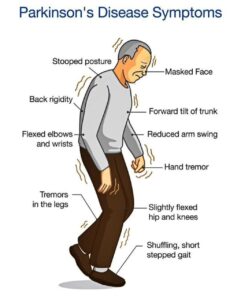
Symptoms/Signs of Parkinson’s Disease
- Rigidity
- Bradykinesia.
- Masks like facial expressions.
- Immobile daily activity
- Wrist sluggish moment
- Shuffling gait
- Speech difficulty
- Dysphagia
- Balance problem
- Propulsive gait
- Impaired gross motor coordination
- Loss of sense of smell
- Swallowing and chewing difficulty
- Frothy saliva from the mouth
- Stop automatic swinging of hand during the walk
- Stooped posture
- Dystonia
- Sexual dysfunction
- Micrographic

What is Parkinson’s Disease Causes, Symptoms & Treatment - Constipation.
Diagnosis of Parkinson’s Disease
- History collection and physical examination.
- CT scan and MRI
- Imaging test
- PET scan
- Mental status examination.
Treatment of Parkinson’s disease
- Levodopa and carbidopa
- Dopamine agonist – bromocriptine
- Anticholinergics – benztropine.
- Monoamine oxidase type – B (MAO – B)
- Antihistamine
- Tricyclic medication
- COMT inhibitor (catechol – o – methyltransferase inhibitors)
- Antiviral substance.
Complications in Parkinson’s disease
- Disability
- Aspiration
- Sexual dysfunction
- Dementia
- Injury from fall
- Cognitive problem.
Who to Manage Parkinson’s disease Patients
- Nurses monitor patients’ daily activity and vital signs.
- Assess physical examination and mental ability.
- Assess patient chewing and swallowing ability.
- Provide soft and fibre diet for easily eating.
- Nursing encourages patients for daily active and passive movement.
- Provide physical and occupational therapy.
- Provide a medical alert bracelet.
- Provide all prescribed medication and maintain IV therapy.
- The nurse monitors the respiration pattern.
- Nurses educate to avoid – high heel shoes
- Hard mattress use
- Vitamin B6.
- The nurse will encourage the patient to do minor tasks.
- The nurse will assist the patient while descending the stairs.
- The nurse will explain to all family members about Parkinson’s.
Important Points about Parkinson’s disease
- What was the first name of Parkinson’s disease – Shaking palsy?
- Parkinson’s disease is a – Neurodegenerative disorder.
- Tried symptoms of Parkinson’s disease – Tremors, rigidity, and bradykinesia.
- The most common cause of Parkinson’s disease – Dopamine deficiency.
- Which neurotransmitter affects Parkinson’s disease – Dopamine
- Parkinson’s disease was discovered by – James Parkinson.
- Parkinson’s disease is a – Progressive brain disorder.
- The average age of onset of Parkinson’s disease is about – 60.
- How many stages of Parkinson’s disease – 4.
- Parkinson’s disease is most commonly found in – Males.
Parkinson’s disease Slideshare
FAQ About Parkinson’s Disease:
What was the first name of Parkinson’s disease?
Shaking palsy
What is Parkinson’s disease?
Neurodegenerative disorder.
What have Tried symptoms of Parkinson’s disease?
These 3 are the main signs of Parkinson’s disease> tremors, rigidity, and bradykinesia.
Which neurotransmitter affects Parkinson’s disease
Dopamine
Parkinson’s disease was discovered by
James Parkinson.
Parkinson’s disease is most commonly found in
Males then Females
-
B.Sc Nursing Entrance Exam 2023-24
B.Sc Nursing Admission 2023-24 To take admission in B.Sc Nursing the Bachelor of Science in Nursing course. Those candidates must have completed 4 years bachelor’s degree from any subject university. Universities select candidates through entrance examinations. The Common Entrance Test starts from April to June. Application forms can be submitted online and offline at the…
-
What are P2P Communities? : A Path to Connection and Collaboration
What are P2P Communities? In the digital age, where technology bridges distances and promotes connectivity across the globe, the concept of peer-to-peer (P2P) communities has emerged as a powerful force promoting collaboration, knowledge-sharing and collective empowerment. Is. P2P communities are reshaping the way we communicate, learn and work together, cutting across geographic boundaries and hierarchical…
-
Hospital Bio-medical waste management 2024
biomedical waste management Hospital biomedical waste is waste that is generated from the medical, surgical, laboratory etc facilities. Hospital waste is capable of causing infectious diseases, so hospital waste management is essential. Hospital waste management means – using various techniques to manage hospitalized waste material to prevent the spread of disease through. eg:- some diseases…