Introduction Parkinson’s disease

- Parkinson’s disease is a neurodegenerative disorder.
- Parkinson’s disease was first described by James Parkinson in 1817 as “shaking palsy“.
- Parkinson’s diseases mainly affect the central nervous system (CNS).
Definition of Parkinson’s disease
Parkinson’s disease is a chronic, progressive neurodegenerative disorder that affects the basal ganglia of the brain and leads to a deficiency of dopamine neurotransmitters. Decrease dopamine neurotransmitter level in the body cause the tried symptoms –
- Tremor
- Bradykinesia
- Rigidity.
Causes of Parkinson’s disease
- Idiopathic
- Genetic disorder
- Age factors
- Exposure to toxin
- Sex (men more exposure)
- Deficiency of dopamine
- Arterial hypertension
- Affect substantia nigra
- Carbon monoxide
- Head injury
- Exposure to Toxins
- Encephalitis
- Atherosclerosis
- Environmental triggers.
-

What is Parkinson’s Disease Causes, Symptoms & Treatment
Pathophysiology (Process of Parkinson’s disease)
Cause
↓
Affect the substantia nigra of basal ganglia
↓
Decrease dopamine production
↓
Degeneration of neurons in basal ganglia
↓
Affect daily routine activity and cause the tremor, rigidity or bradykinesia
↓
Parkinson disease.
Symptoms/Signs of Parkinson’s Disease
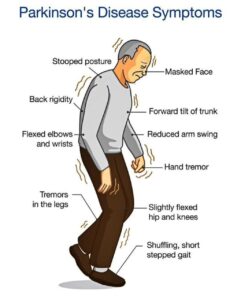
- Classical symptoms of Parkinson – tremor
Symptoms/Signs of Parkinson’s Disease
- Rigidity
- Bradykinesia.
- Masks like facial expressions.
- Immobile daily activity
- Wrist sluggish moment
- Shuffling gait
- Speech difficulty
- Dysphagia
- Balance problem
- Propulsive gait
- Impaired gross motor coordination
- Loss of sense of smell
- Swallowing and chewing difficulty
- Frothy saliva from the mouth
- Stop automatic swinging of hand during the walk
- Stooped posture
- Dystonia
- Sexual dysfunction
- Micrographic

What is Parkinson’s Disease Causes, Symptoms & Treatment - Constipation.
Diagnosis of Parkinson’s Disease
- History collection and physical examination.
- CT scan and MRI
- Imaging test
- PET scan
- Mental status examination.
Treatment of Parkinson’s disease
- Levodopa and carbidopa
- Dopamine agonist – bromocriptine
- Anticholinergics – benztropine.
- Monoamine oxidase type – B (MAO – B)
- Antihistamine
- Tricyclic medication
- COMT inhibitor (catechol – o – methyltransferase inhibitors)
- Antiviral substance.
Complications in Parkinson’s disease
- Disability
- Aspiration
- Sexual dysfunction
- Dementia
- Injury from fall
- Cognitive problem.
Who to Manage Parkinson’s disease Patients
- Nurses monitor patients’ daily activity and vital signs.
- Assess physical examination and mental ability.
- Assess patient chewing and swallowing ability.
- Provide soft and fibre diet for easily eating.
- Nursing encourages patients for daily active and passive movement.
- Provide physical and occupational therapy.
- Provide a medical alert bracelet.
- Provide all prescribed medication and maintain IV therapy.
- The nurse monitors the respiration pattern.
- Nurses educate to avoid – high heel shoes
- Hard mattress use
- Vitamin B6.
- The nurse will encourage the patient to do minor tasks.
- The nurse will assist the patient while descending the stairs.
- The nurse will explain to all family members about Parkinson’s.
Important Points about Parkinson’s disease
- What was the first name of Parkinson’s disease – Shaking palsy?
- Parkinson’s disease is a – Neurodegenerative disorder.
- Tried symptoms of Parkinson’s disease – Tremors, rigidity, and bradykinesia.
- The most common cause of Parkinson’s disease – Dopamine deficiency.
- Which neurotransmitter affects Parkinson’s disease – Dopamine
- Parkinson’s disease was discovered by – James Parkinson.
- Parkinson’s disease is a – Progressive brain disorder.
- The average age of onset of Parkinson’s disease is about – 60.
- How many stages of Parkinson’s disease – 4.
- Parkinson’s disease is most commonly found in – Males.
Parkinson’s disease Slideshare
FAQ About Parkinson’s Disease:
What was the first name of Parkinson’s disease?
Shaking palsy
What is Parkinson’s disease?
Neurodegenerative disorder.
What have Tried symptoms of Parkinson’s disease?
These 3 are the main signs of Parkinson’s disease> tremors, rigidity, and bradykinesia.
Which neurotransmitter affects Parkinson’s disease
Dopamine
Parkinson’s disease was discovered by
James Parkinson.
Parkinson’s disease is most commonly found in
Males then Females
-
pentavalent vaccine पेंटावैलेंट वैक्सीन को याद कर ने का तरीका
Pentavalent vaccine PENTA = 5 VELENT = VACCINE Group of 5 Vaccine called Pentavalent Trick DPT -2H D = Diptheria P = Pertusis T = tetanus H = Hep- B H = Hib pentavalent vaccine missionnursing.in WhatsApp Group Join Now Telegram Group Join Now
-
sign and symptoms of pregnancy/ pregnancy symptoms/early signs of pregnancy
SIGNS AND SYMPTOMS OF PREGNANCY INTRODUCTION Signs and symptoms that are usually noted by the patient, impel her to form a meeting with a physician for confirmation of pregnancy. What is pregnancy:- DEFINITION OF PREGNANCY it’s the state of carrying a developing embryo or fetus within the feminine body from conception to birth. After…
-
Objective type questions and answers for staff nurse exam
Objective Type Questions and Answers for Staff Nurse Exam PDF 1. A 43-year-old African yank male is admitted with erythrocyte anemia. The nurse plans to assess circulation within the lower extremities each 2 hours. that of the subsequent outcome criteria would the nurse use? ❍ A. vital sign of 99°F or less ❍ B. Toes emotional in active vary of motion ❍ C. Sensation according to once soles of feet area unit touched ❍ D. Capillary refill of < three seconds 2.…