Introduction Parkinson’s disease

- Parkinson’s disease is a neurodegenerative disorder.
- Parkinson’s disease was first described by James Parkinson in 1817 as “shaking palsy“.
- Parkinson’s diseases mainly affect the central nervous system (CNS).
Definition of Parkinson’s disease
Parkinson’s disease is a chronic, progressive neurodegenerative disorder that affects the basal ganglia of the brain and leads to a deficiency of dopamine neurotransmitters. Decrease dopamine neurotransmitter level in the body cause the tried symptoms –
- Tremor
- Bradykinesia
- Rigidity.
Causes of Parkinson’s disease
- Idiopathic
- Genetic disorder
- Age factors
- Exposure to toxin
- Sex (men more exposure)
- Deficiency of dopamine
- Arterial hypertension
- Affect substantia nigra
- Carbon monoxide
- Head injury
- Exposure to Toxins
- Encephalitis
- Atherosclerosis
- Environmental triggers.
-

What is Parkinson’s Disease Causes, Symptoms & Treatment
Pathophysiology (Process of Parkinson’s disease)
Cause
↓
Affect the substantia nigra of basal ganglia
↓
Decrease dopamine production
↓
Degeneration of neurons in basal ganglia
↓
Affect daily routine activity and cause the tremor, rigidity or bradykinesia
↓
Parkinson disease.
Symptoms/Signs of Parkinson’s Disease
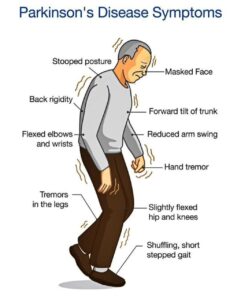
- Classical symptoms of Parkinson – tremor
Symptoms/Signs of Parkinson’s Disease
- Rigidity
- Bradykinesia.
- Masks like facial expressions.
- Immobile daily activity
- Wrist sluggish moment
- Shuffling gait
- Speech difficulty
- Dysphagia
- Balance problem
- Propulsive gait
- Impaired gross motor coordination
- Loss of sense of smell
- Swallowing and chewing difficulty
- Frothy saliva from the mouth
- Stop automatic swinging of hand during the walk
- Stooped posture
- Dystonia
- Sexual dysfunction
- Micrographic

What is Parkinson’s Disease Causes, Symptoms & Treatment - Constipation.
Diagnosis of Parkinson’s Disease
- History collection and physical examination.
- CT scan and MRI
- Imaging test
- PET scan
- Mental status examination.
Treatment of Parkinson’s disease
- Levodopa and carbidopa
- Dopamine agonist – bromocriptine
- Anticholinergics – benztropine.
- Monoamine oxidase type – B (MAO – B)
- Antihistamine
- Tricyclic medication
- COMT inhibitor (catechol – o – methyltransferase inhibitors)
- Antiviral substance.
Complications in Parkinson’s disease
- Disability
- Aspiration
- Sexual dysfunction
- Dementia
- Injury from fall
- Cognitive problem.
Who to Manage Parkinson’s disease Patients
- Nurses monitor patients’ daily activity and vital signs.
- Assess physical examination and mental ability.
- Assess patient chewing and swallowing ability.
- Provide soft and fibre diet for easily eating.
- Nursing encourages patients for daily active and passive movement.
- Provide physical and occupational therapy.
- Provide a medical alert bracelet.
- Provide all prescribed medication and maintain IV therapy.
- The nurse monitors the respiration pattern.
- Nurses educate to avoid – high heel shoes
- Hard mattress use
- Vitamin B6.
- The nurse will encourage the patient to do minor tasks.
- The nurse will assist the patient while descending the stairs.
- The nurse will explain to all family members about Parkinson’s.
Important Points about Parkinson’s disease
- What was the first name of Parkinson’s disease – Shaking palsy?
- Parkinson’s disease is a – Neurodegenerative disorder.
- Tried symptoms of Parkinson’s disease – Tremors, rigidity, and bradykinesia.
- The most common cause of Parkinson’s disease – Dopamine deficiency.
- Which neurotransmitter affects Parkinson’s disease – Dopamine
- Parkinson’s disease was discovered by – James Parkinson.
- Parkinson’s disease is a – Progressive brain disorder.
- The average age of onset of Parkinson’s disease is about – 60.
- How many stages of Parkinson’s disease – 4.
- Parkinson’s disease is most commonly found in – Males.
Parkinson’s disease Slideshare
FAQ About Parkinson’s Disease:
What was the first name of Parkinson’s disease?
Shaking palsy
What is Parkinson’s disease?
Neurodegenerative disorder.
What have Tried symptoms of Parkinson’s disease?
These 3 are the main signs of Parkinson’s disease> tremors, rigidity, and bradykinesia.
Which neurotransmitter affects Parkinson’s disease
Dopamine
Parkinson’s disease was discovered by
James Parkinson.
Parkinson’s disease is most commonly found in
Males then Females
-
Handwritten NEET Notes Physics Chemistry & Biology
How to mack Handwritten NEET Notes Handwritten NEET Notes for NEET 2024 Exams. Preparing for the National Eligibility cum Entrance Test (NEET) is an exciting yet demanding journey for aspiring medical students in India. Keeping in mind the tough competition and vast syllabus, effective study techniques are important. Out of these, the art of making…
-
how to get admission in AIIMS for Bsc nursing?
AIIMS BSc Nursing Eligibility:- As per the AIIMS of AIIMS for admission in AIIMS Bsc nursing, the admission process is open for candidates who have completed their 12th class from the science stream from any recognized examination board. Applicants must have at least 55% marks in their class 12th exam to apply for the admission…
-
Stool Sample Collection Technique and Instruction
Human faeces are called the stool. Meconium is a newborn first stool. Stool sample collection is a procedure in which stool should be collected in a dry or sterilized wide-mouthed container to identify the pathological condition. Stool sample collection methods require universal precautions. Commonly morning samples should be collected. Patients avoid antibiotic therapy and iron…